
AI Summary
For generations medicine has treated illness after it appears. But what if tomorrow's biggest medical breakthrough happens before you're even born?
Khensani: "My uncle says medicine is becoming too expensive."
Mpho: "Maybe because people are getting sicker."
Khensani: "Or maybe because medicine is changing."
Mpho: "Changing how?"
Khensani: "What if the next breakthrough isn't another tablet... but making sure you never need one?"
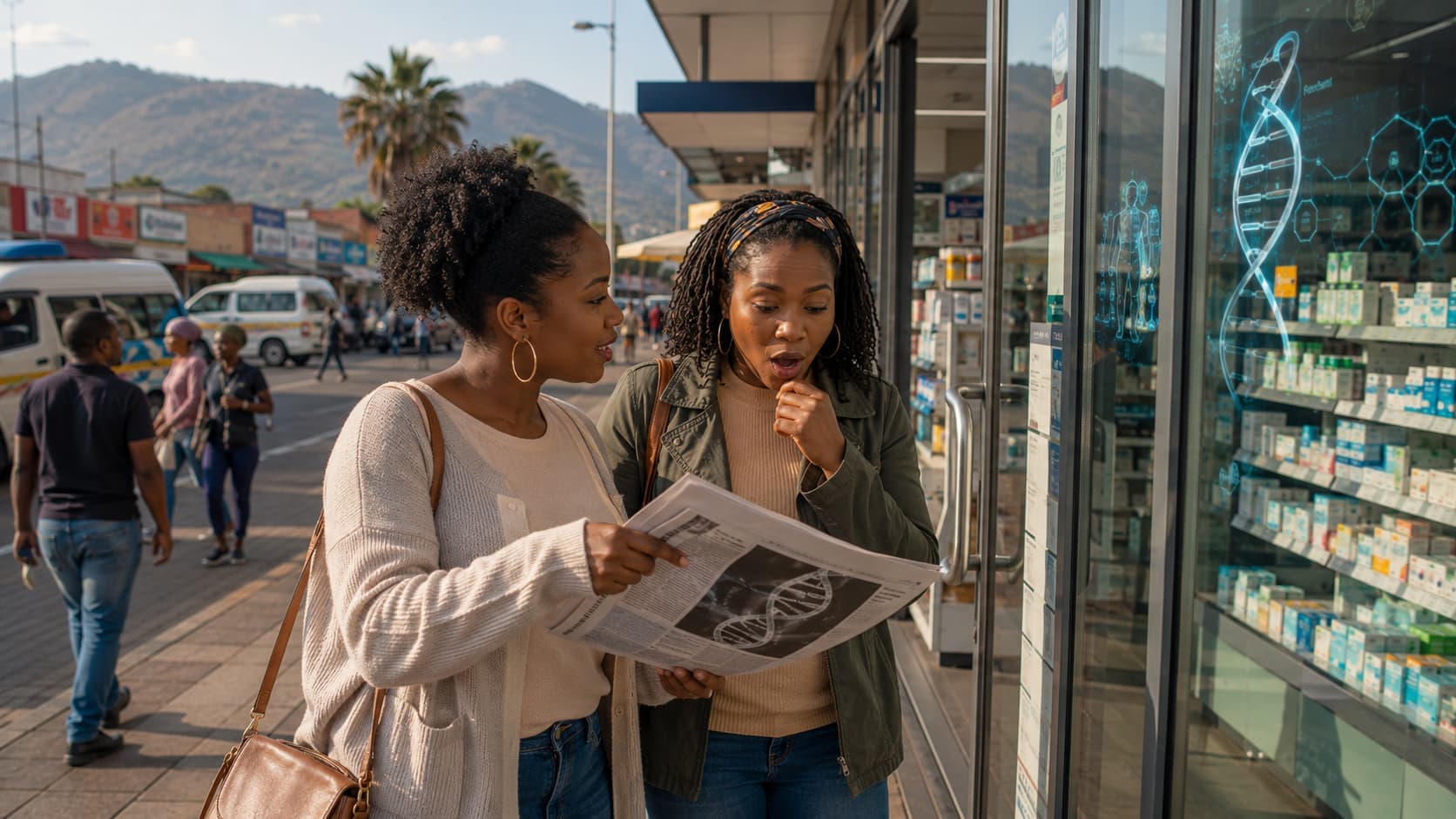
They both looked at each other while waiting for coffee outside a pharmacy in Mbombela.
Neither of them realised they were about to talk about one of the biggest changes happening in healthcare.
Medicine has always worked one way
For most of history, healthcare has followed a simple pattern.
You become sick.
A doctor diagnoses the illness.
You receive treatment.
You recover.
Sometimes the treatment works.
Sometimes it manages the illness for years.
But scientists are now asking a completely different question.
What if we could stop certain diseases before they ever begin?
First, let's understand one important word
You have probably heard people talk about DNA.
It sounds scientific.
But the idea is surprisingly simple.
Imagine building a house in Polokwane.
You wouldn't start without a blueprint.
Your body also has one.
That blueprint is called DNA.
It contains the instructions that tell your body how to grow, develop and function.
Then what is a gene?
Think of DNA as an entire instruction manual.
Each individual instruction inside that manual is called a gene.
Some genes influence eye colour.
Others help your immune system.
Some are linked to inherited diseases.
Scientists are now learning how to repair certain faulty instructions instead of simply treating the symptoms they cause.
You've probably heard another strange word
Genome editing.
It sounds complicated.
It simply means changing a very small part of those biological instructions.
One of the best-known technologies used for this is called CRISPR.
Many scientists compare it to carefully editing a spelling mistake inside an enormous instruction book.
Not every mistake can be corrected.
But some already can.
Why pharmaceutical companies are paying attention
For decades, medicine has often focused on helping people live with disease.
Now researchers are asking whether some conditions can be prevented by correcting the underlying genetic problem.
If that becomes possible for more diseases, the pharmaceutical industry could change dramatically.
Instead of producing medicines that are taken every day for years, companies may increasingly invest in treatments designed to solve certain problems much earlier.
That is one of the reasons biotechnology has become one of the fastest-growing areas in healthcare.
South Africa won't watch from the sidelines
This isn't only a conversation for laboratories in Europe or America.
South African researchers are already involved in genetics and medical research.
Universities, hospitals and biotechnology companies are investing in understanding inherited diseases and personalised medicine.
As these technologies become more common, they'll raise important questions for our healthcare system, our medical aids and our regulations.
But it also raises uncomfortable questions
If doctors can prevent certain inherited diseases...
Should they?
If they can edit DNA...
Where should they stop?
Preventing illness is one conversation.
Choosing human characteristics is a completely different one.
Medicine, business, ethics, religion and law may all find themselves sitting at the same table.
Understanding the jargon changes the conversation
The words DNA, genes, genome editing and CRISPR are appearing more often every year.
They're no longer only scientific terms.
They're becoming business terms.
Investment terms.
Healthcare terms.
Even political terms.
The more we understand them today, the easier tomorrow's conversations become.
Final thoughts
Most of us grew up believing medicine begins after someone becomes sick.
The next generation may grow up believing medicine begins long before that.
Whether genome editing becomes common or remains limited to certain diseases, one thing is already changing.
The biggest innovation in healthcare may not be creating better medicine.
It may be reducing the need for medicine in the first place.
That's a conversation worth having over coffee.
Related articles
The Office Was Arguing About Blockchain. Nobody Actually Knew What It Was. (Coming Soon)
Everyone's Talking About Bitcoin. Very Few People Can Explain It.
The Day I Realised the Bank Wasn't a Giant Safe. (Coming Soon)
How Fear Silently Controls Our Decisions. (Coming Soon)

Creative Strategist at Chesly.Tech.