
Know which tenders are worth bidding for.
Answer twelve questions about the tender in front of you. Get a score, a recommendation, and a printable record of why you decided what you decided — before you spend two weeks on a bid you were never going to win.
1. The tender
Used on your printed decision record.
2. Qualify the opportunity
Answer honestly. “Unsure” scores half — it is not a free pass, it is a task you still have to do.
3. Why the calculator says this
Every strength and risk below traces back to an answer you gave.
Strengths
Nothing confirmed yet.
Risks and gaps
Nothing flagged yet.
4. Price and profitability
All figures in rand, excluding VAT. Leave anything that doesn’t apply at zero.
| Tender price | R 0 |
| Costs | |
| Total direct cost | R 0 |
| Total overhead | R 0 |
| Contingency (5%) | R 0 |
| Total estimated cost | R 0 |
| Result | |
| Gross profit | R 0 |
| Gross margin | 0.0% |
| Markup on cost | 0.0% |
| Per month over 12 months | |
| Revenue | R 0 |
| Cost | R 0 |
| Profit | R 0 |
| Working backwards | |
| Price for a 20% margin | R 0 |
| Cash you must carry before payment | R 0 |
5. Your decision
You can overrule the calculator. It just wants the reason on record.
Nothing you type here is sent anywhere. It stays in this browser tab until you close it. Print to PDF to keep it.
This is one tender. The South African Tender Toolkit handles every tender you assess.
A full spreadsheet workspace — a tender register that tracks your win rate, this bid scorer and pricing model built as reusable formulas, a compliance register that flags expiring documents before they cost you a bid, a submission checklist, and a printable decision record.
Get the Tender ToolkitWhy most South African SMEs bid far too often
A tender submission costs a small business somewhere between forty and a hundred and twenty hours once you count the site meeting, the pricing schedule, chasing certified copies, and the two evenings spent formatting a technical proposal.
Price that at even R350 an hour of owner and admin time and a single bid costs you R14,000 to R42,000 before you print a page. Most SMEs never account for it, because it does not appear on a bank statement. It appears as the month you had no time to invoice.
Five carefully chosen bids at a 40% win rate returns two contracts.
Twenty scattered bids at a 10% win rate returns the same two contracts, for four times the work.
The difference between those two businesses is not luck. It is eighteen decisions to walk away.
The discipline is not in writing better bids. It is in writing fewer of them, and putting the recovered time into the ones you can actually win. That is the entire purpose of a bid/no-bid decision.
Why “unsure” is the most dangerous answer
In the calculator above, an unsure answer scores half marks — not because half is fair, but because unsure is not neutral. Every unsure is an unfinished task with a deadline attached. If four criteria are unsure a week before closing, you do not have a 70% opportunity. You have a 70% opportunity and four unpaid days of work standing between you and finding out.
The twelve criteria, explained for South African tenders
Why each one carries the weight it does.
Mandatory requirements weight 15 · disqualifier
Public tenders are evaluated in stages, and the first stage is administrative compliance. If a mandatory return is missing, your envelope is set aside before anyone reads your price. This carries the heaviest weight and acts as a hard gate for exactly that reason.
Certifications and registrations weight 10 · disqualifier
An active CSD profile, a current SARS Tax Compliance Status PIN, a valid B-BBEE certificate or sworn affidavit, and any sector licence — CIDB grading for construction, PSIRA for security, a COIDA Letter of Good Standing for almost anything involving staff on site. These are pass/fail, not points.
Experience and references weight 10
Functionality scoring usually asks for comparable contracts of similar value, with contactable references on a letterhead. “We can do it” scores nothing. A signed reference letter for a similar-sized job scores.
Ability to deliver weight 10
Winning work you cannot deliver is worse than losing it. Penalties, a damaged reference and possible restriction from future bidding cost more than the contract was worth.
Profit margin weight 10
Scored separately from contract value, because a large contract at 4% is a worse business than a small one at 25%. Use the costing section above before you answer this one.
Cash flow weight 9
The quiet killer of South African SMEs on public work. You buy materials and pay wages in week one; the invoice goes out at month end; payment terms are thirty days and are not always met. Municipal and SOE work is slower than national departments.
Turnover and financial standing weight 8
Many tenders set a minimum annual turnover or require audited financials. Some are explicit; some hide it in the returnable schedules. Check before you price, not after.
Resources weight 8
People, plant and vehicles that are genuinely free for that period — not the same team you have already promised to another site.
Contract value fit weight 7
A contract that is too large strains cash flow and delivery; one that is too small does not repay the bid cost. Both are reasons to decline.
Location weight 6
Travel, accommodation and supervision across provinces are real costs that quietly eat margin. A Gauteng contractor servicing a Limpopo site needs those numbers in the costing, not in their head.
Time to closing weight 5
If a compulsory briefing has passed, the decision is already made for you. If two weeks remain and three documents are outstanding, be honest about whether the submission will be complete or merely submitted.
Strategic value weight 2
Deliberately the smallest weight. Strategic value is the most common excuse for bidding on work that makes no commercial sense. It should tip a borderline decision, never rescue a bad one.
What gets South African bids thrown out before pricing is opened
- ✓An expired B-BBEE certificate or affidavit. Valid for twelve months. The single most common disqualifier, because bidders reuse the copy from their last submission without checking the date.
- ✓No CSD registration, or a CSD profile with details that do not match. The buyer pulls your profile from the database. If the CIPC name, banking letter and ID copies disagree, that is a finding against you.
- ✓A missing or lapsed SARS Tax Compliance Status PIN. The old tax clearance certificate was withdrawn in 2016. Buyers verify your status live.
- ✓Uncertified or stale ID copies. Certification is generally required within the last three months, for every listed director.
- ✓Unsigned SBD forms or declarations. An unsigned declaration is treated as an incomplete return.
- ✓A pricing schedule altered, left incomplete, or priced in the wrong format. Use their schedule, in their format, filled in completely.
- ✓Missing the compulsory briefing or site inspection. No attendance certificate, no bid. This one cannot be fixed afterwards.
- ✓No COIDA Letter of Good Standing where staff will be on the buyer's premises.
- ✓Late submission. A tender closing at 11:00 means the box is sealed at 11:00.
- ✓Documents attached in the wrong envelope or the wrong file on the electronic portal.
Nine of these ten are administrative. None of them are about whether you could have done the work well. That is what makes them worth a checklist.
Compliance documents and how long they last
The documents most often requested. Always confirm against the tender document itself.
| Document | Where it comes from | Typical validity |
|---|---|---|
| CSD registration | National Treasury, csd.gov.za | Ongoing — update within 30 days of any change |
| Tax Compliance Status PIN | SARS eFiling | Verified live by the buyer; keep standing current |
| B-BBEE certificate or sworn affidavit | SANAS-accredited agency, or commissioner of oaths for an EME/QSE affidavit | 12 months |
| CIPC company documents | CIPC | Ongoing — annual returns must be up to date |
| Banking confirmation letter | Your bank, business account in the registered name | Commonly required within 3 months |
| Certified ID copies, all directors | Commissioner of oaths | Commonly required within 3 months |
| COIDA Letter of Good Standing | Compensation Fund | 12 months |
| Public liability insurance | Your insurer | Annual |
| CIDB grading (construction) | CIDB | Renewable, grade must match contract value |
| PSIRA registration (security) | PSIRA | Annual |
| Financial statements | Your accountant | Usually the last 1–3 financial years |
| Reference letters | Past clients, on letterhead | No expiry, but recency counts in scoring |
An EME with turnover below R10 million can generally use a sworn affidavit rather than paying for a verification certificate. Note also that the Public Procurement Act 28 of 2024 has been signed and draft regulations were published in April 2026 — the day-to-day picture has not shifted yet, but check the tender document rather than assuming last year’s rules.
A worked example
A Gauteng cleaning company is looking at a twelve-month contract for a municipal building, advertised around R2,000,000.
- Labour for eight cleaners and a supervisor: R1,180,000
- Consumables and chemicals: R210,000
- Equipment and machine servicing: R95,000
- Transport and supervision visits: R88,000
- Administration, insurance and finance costs: R160,000
That is R1,733,000 before contingency. Add 5% and the total cost is R1,819,650, leaving a gross profit of R180,350 — a margin of 9.0%. Against a written minimum of 15%, this is a no-bid on price alone; the company would need roughly R2,140,000 to reach a 15% margin.
The cash-flow line matters just as much. At roughly R151,600 of cost per month and thirty-day payment terms, the company must fund about R151,600 of wages and consumables before the first invoice is paid — and municipal payment is frequently slower than thirty days. On a 9% margin, one late payment cycle consumes most of the year’s profit.
The useful outcome here is not “we lost”. It is a documented reason to decline, and a number — R2,140,000 — to test against the market before the next similar tender appears.
Common questions
What is a bid/no-bid decision?
A bid/no-bid decision is a structured assessment of whether a tender is worth pursuing, made before you commit staff time to writing the submission. It weighs compliance, capability, commercial return and cash flow against each other so that the choice to walk away is a deliberate strategic decision rather than an accident.
Do I need CSD registration to bid on a South African government tender?
Yes. Every bidder must be registered on the National Treasury Central Supplier Database at csd.gov.za before submitting a bid to an organ of state. Registration itself is free and generally takes between one and three weeks, with most delays caused by name mismatches between CIPC records, the banking confirmation letter and director IDs.
How long is a B-BBEE certificate valid for a tender?
Twelve months. An expired B-BBEE certificate or sworn affidavit is one of the most common reasons a bid is disqualified, because many bidders reuse the version from their previous submission without checking the date.
Do I still need a tax clearance certificate for tenders?
No. The tax clearance certificate was retired in 2016 and replaced by the SARS Tax Compliance Status PIN, requested through eFiling, which allows the buyer to verify your status online at the time of evaluation.
What profit margin should a South African SME target on a tender?
There is no single correct figure, but a margin that survives only if nothing goes wrong is not a margin. Set a written minimum before you price, hold a contingency of at least five per cent of cost, and treat any margin close to that floor as a no-bid rather than a stretch.
Is this calculator legal or financial advice?
No. It is a planning and organisation tool. It does not verify your compliance status and does not replace the tender document, your accountant or your attorney. Confirm every requirement against the tender document itself before submitting.
Can I override the recommendation?
Yes, and sometimes you should — a first reference in a sector you want long-term can justify a thin margin. The calculator only asks you to write the reason down. Six months later, that one line is the difference between a strategic decision you can learn from and a mistake you will repeat.
Is my data stored anywhere?
No. Everything stays in your browser tab and disappears when you close it. Nothing is uploaded, and there is no signup. Print to PDF if you want to keep the record.
This is a planning and organisation tool. It does not verify your compliance status and it is not legal, tax or financial advice. Confirm every requirement against the tender document itself and with your own advisors before submitting.
From the Business Tools
View All →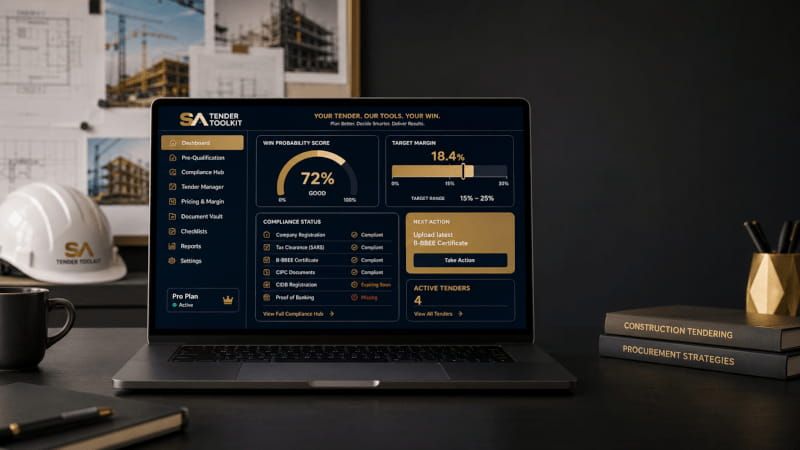
South African Tender Toolkit
A dashboard-first Excel toolkit that takes you from a tender advert to a defensible decision in about twenty minutes — across nine linked tabs covering Bid Scoring, Pricing, Compliance, Submission and a printable Decision Record. Twelve weighted criteria produce a Bid Score out of 100 with a clear recommendation, a full costing model shows the margin the tender price actually leaves you, and five automatic conflict checks fire when two tabs disagree — so you find out a contract is unprofitable before you spend three weeks winning it.
Premium — R750
🛒 Add to Cart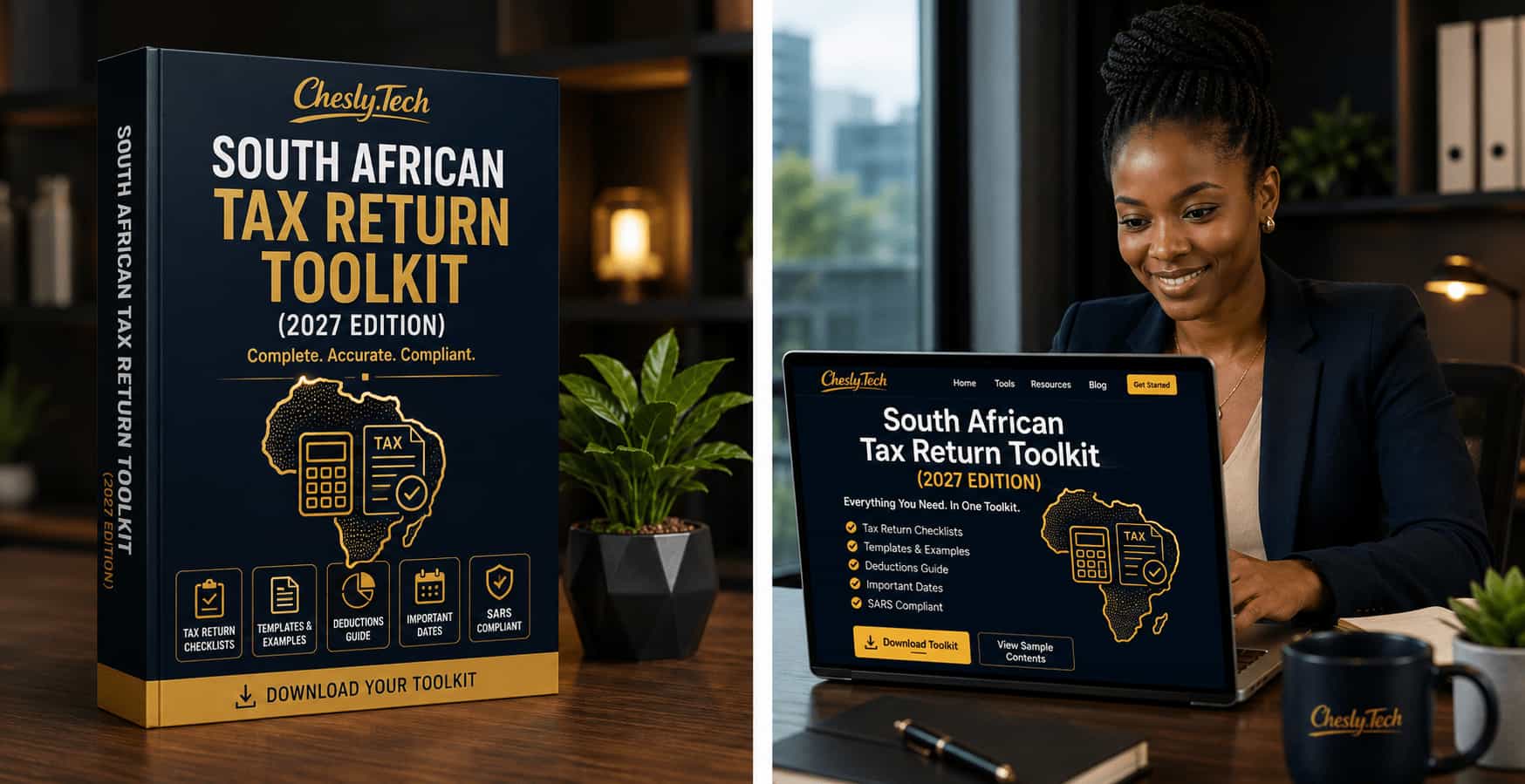
South African Tax Return Toolkit (2027 Edition)
A dashboard-first Excel toolkit that walks you from a blank return to a submit-ready SARS filing in 5 guided steps — Your Profile, Document Checklist, Income & Deductions, Tax Calculation, and Ready to Submit. Built on the actual 2026/2027 SARS tax tables, it shows your Tax Readiness Score, your estimated refund or amount owing, and a Decision Coach explaining what each entry means and what to double-check — so nothing is left to guesswork before you file.
Premium — R750
🛒 Add to Cart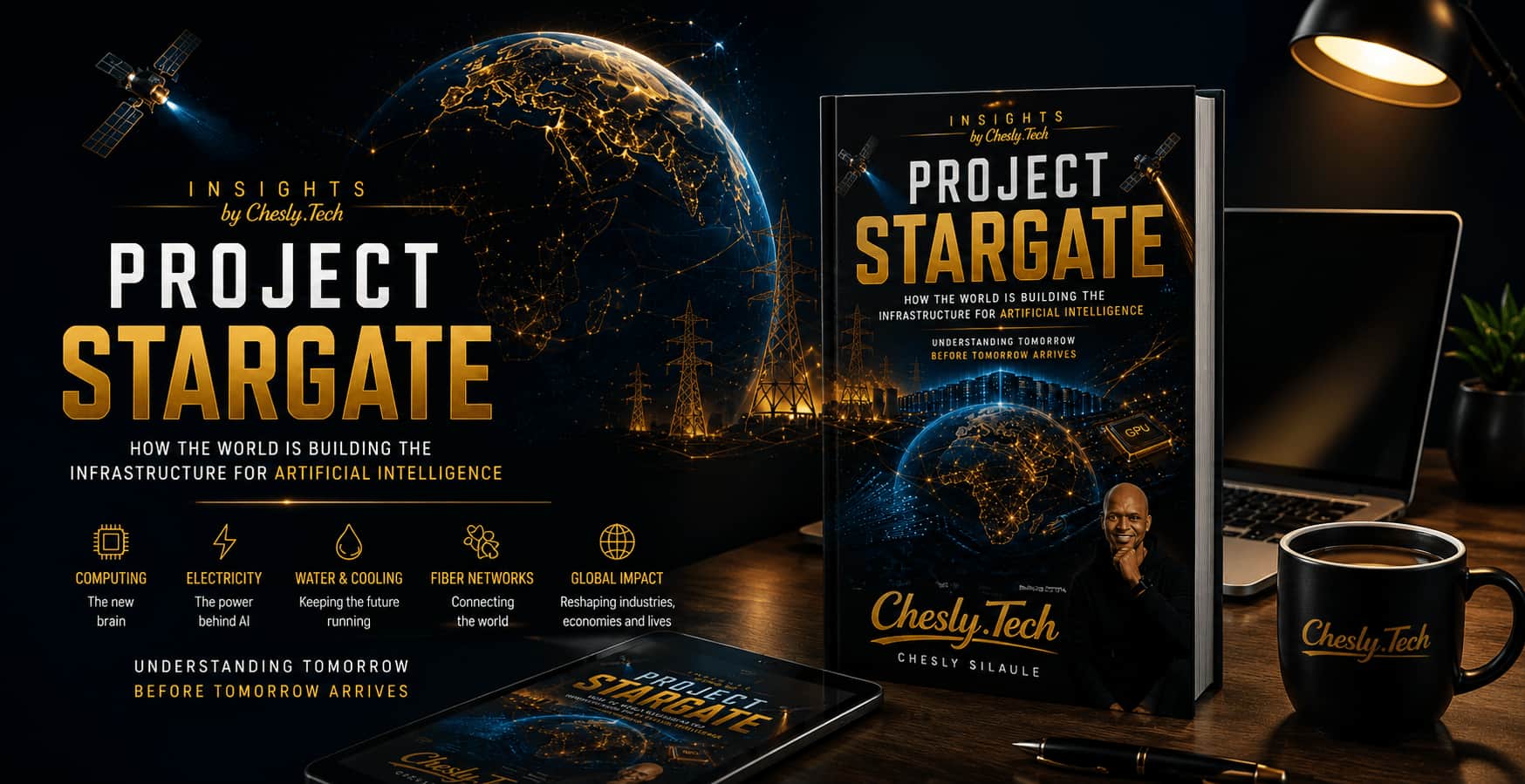
Project Stargate: Understanding AI Billion $ Infrastructure
Project Stargate is a plain-English guide to one of the biggest AI infrastructure projects ever announced. The book follows the money, chips, power, data centres and construction behind the Stargate buildout, explaining who is involved, how the financing works, why electricity may be the real bottleneck, and what the project could mean for jobs, businesses and Africa. It also separates established facts from forecasts and open questions, helping readers understand what is happening now without treating uncertain predictions as certainty.
Free
Get for Free
Income & Expense Tracker – South African Edition
Avoid costly funding mistakes before you apply. This free Excel toolkit helps South African businesses calculate the real cost of purchase order funding, assess funding readiness, organise required documents and understand how PO funding works—giving you greater confidence before approaching a funder.
Premium — R250
🛒 Add to Cart