
AI Summary
Most business owners can name copyright, trademarks and patents but couldn't explain the difference. Here's what each one actually protects — and why a single product can carry all four at once.
Most business owners have heard of copyright, trademarks and patents. Far fewer could actually explain the difference between them — or realise that a single product can be protected by all four types of intellectual property at once, each covering a completely different part of it.
Understanding the difference matters because each one protects something different, works differently, and requires a different kind of action to actually secure it. Assuming "I registered my trademark, so my business is protected" is one of the most common — and costly — misunderstandings entrepreneurs make.
Copyright — protects what you create
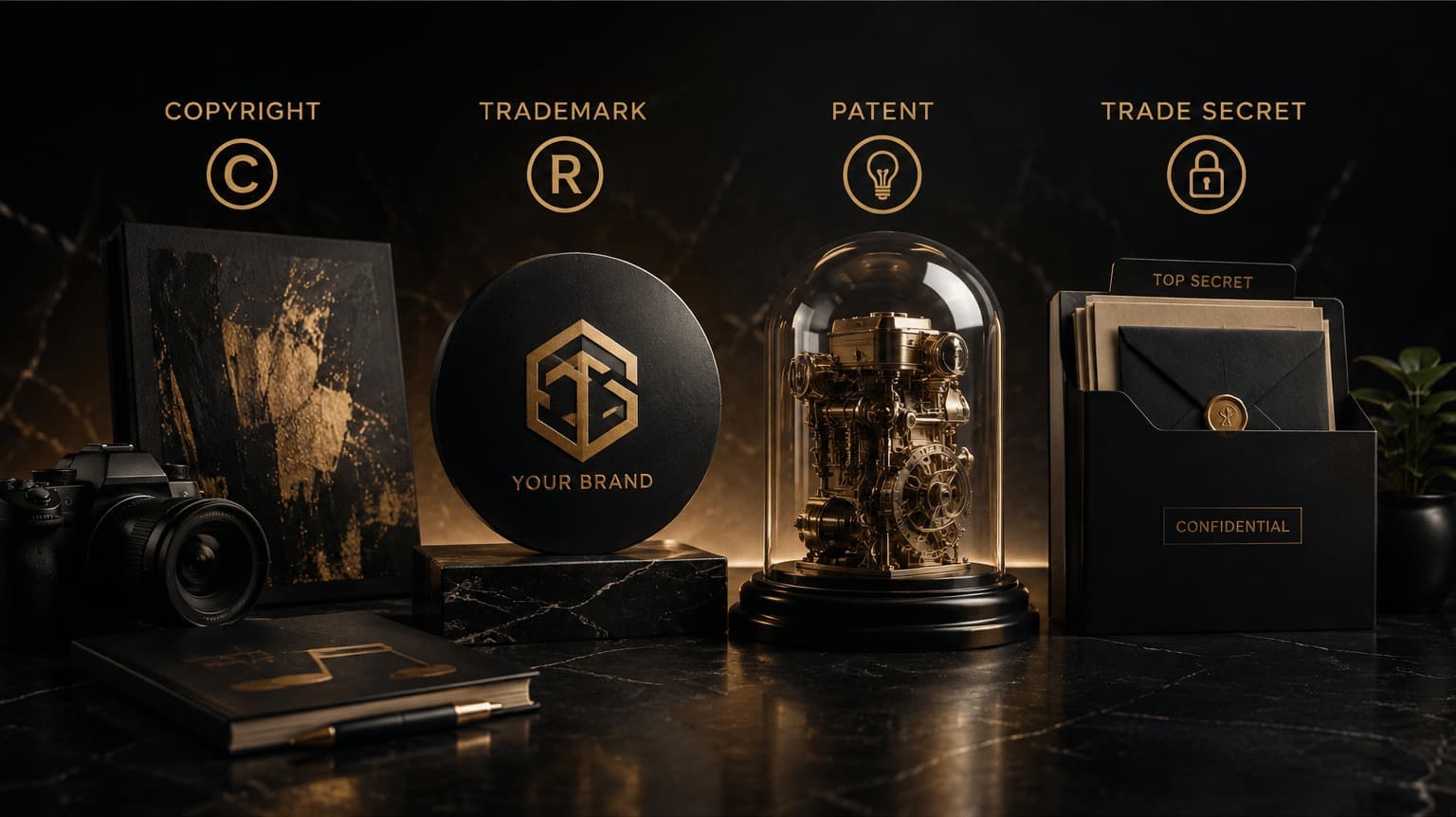
Copyright covers original creative expression: music and songs, photographs and videos, websites and software code, books, articles, artwork and graphic designs.
If you design a logo illustration or write a song, copyright is what protects that specific creative expression — not the underlying idea behind it, but the actual expression you produced. In South Africa, as in most countries, copyright typically arises automatically the moment you create an original work; there's generally no formal registration process required for it to exist.
Trademark — protects your brand and identifiers
A trademark protects business names, logos, slogans and taglines, product names, and sometimes even distinctive sounds or shapes associated with a brand.
The purpose of a trademark isn't to protect the creative work itself — that's copyright's job — but to stop other businesses from using confusingly similar branding for related goods or services. A name, logo or slogan could all potentially qualify as trademarks in their own right. In South Africa, trademarks are registered through the Companies and Intellectual Property Commission (CIPC), a separate process entirely from registering a company name.
Patent — protects new inventions
A patent protects a new machine, a new technical process, a new device or technical improvement, or certain new compositions or products.
Patents are fundamentally about how something works, not simply what it looks like — that distinction is what separates a patent from a design or copyright claim. Patents are also generally time-limited and require a formal application process; unlike copyright, they don't exist automatically just because you invented something.
Trade secret — protects valuable confidential information
A trade secret protects secret formulas, proprietary processes, algorithms or methods kept confidential, customer or supplier information, and business strategies.
The key requirement is that you don't disclose the information publicly and that you take reasonable steps to actually keep it secret. Unlike the other three categories, there's no registration process at all — the protection exists precisely because, and only for as long as, the information stays confidential.
The easiest way to remember all four
Copyright = what you create. Trademark = what you call it, or how people identify you. Patent = what you invent. Trade secret = what you know but keep secret.
[H2] One product, four different kinds of protection
Here's the part that surprises most entrepreneurs: you can have several forms of IP protection around a single product simultaneously, because each one is protecting a completely different layer of it.
Imagine you create a new construction calculator called BuildMetric. The name "BuildMetric" would potentially be a trademark. The logo would be protected by copyright, and could potentially also be trademarked. The underlying software code is protected by copyright. If the calculator uses a genuinely new technical calculation method or system, that could potentially be patentable. And your undisclosed algorithm or business logic behind how it actually works could be protected as a trade secret.
That's why businesses need to think about intellectual property as a portfolio — a set of different protections covering different layers of the same product — rather than treating "registering a trademark" as a single box to tick and move on.
Why this matters in practice
Getting this distinction wrong has real consequences. A business that only registers a trademark, assuming that also protects its software code, has left that code without the copyright-specific protections and remedies it's actually entitled to. A business relying on an NDA to protect an idea, without understanding that ideas themselves generally aren't protectable IP at all, may find that agreement offers far less protection than they assumed.
Taking stock of what you've actually built — the name, the logo, the code, any genuinely novel technical process, and anything you're deliberately keeping confidential — and matching each piece to the right form of protection is a far more useful exercise than simply asking a lawyer to "trademark the business."
Frequently Asked Questions
Do I need to register my work for copyright to apply?
Generally no — copyright typically arises automatically the moment you create an original work, without a formal registration process.
Is a business name automatically a registered trademark?
No — registering a company name through CIPC is a separate process from trademark registration, and only trademark registration gives you the exclusive right to stop others using a confusingly similar brand.
Can a business idea itself be patented?
No — patents protect a specific, new and inventive technical solution, not a general idea or business method on its own.
Can one product have more than one type of IP protection?
Yes — a single product's name, logo, code, technical process and confidential business logic can each be protected by a different form of IP at the same time.

Creative Strategist at Chesly.Tech.